Occupational Therapy vs Physical Therapy: How They Work Together
Rehabilitation generally falls into two different types of profession. When looking at improving function following injury, neurological issues, or supporting physical development for your child, Physical Therapy (PT) and Occupational Therapy (OT) will be central.
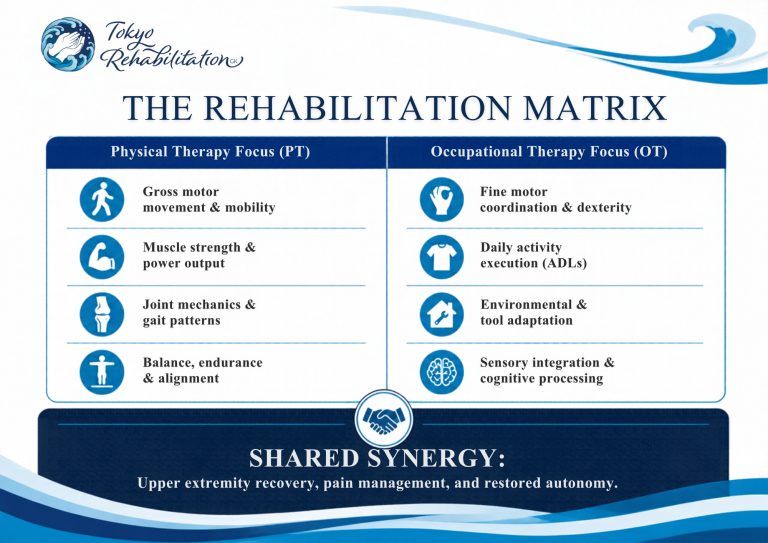
Both PT and OT aim to improve movement, increase independence, and reduce pain. However, OT looks at applying physical skills gained during PT sessions to everyday activities. PT will look at increasing the physical strength and structure of the body to improve gross motor skills, joint mobility, and balance. Whereas OT will look at improving fine motor skills and cognition and adapting to complete activities.
PT and OT work well together. Often OT will perform similar treatments to PT. When looking at upper limb injuries, shoulder mobility and hand rehabilitation treatment will be very similar. At Tokyo Rehabilitation (Tokyo Rehab), we use PT and OT together so clients will not only increase their physical strength but will also learn to apply this to increase their independence.
Gross Motor Skills vs. Fine Motor Skills
It can be useful to understand how PT and OT differ.
Physical therapists work on improving gross motor skills. This includes large muscle movements such as standing, walking, running, climbing stairs, and shifting weight. If a client is recovering from knee surgery or suffering from back pain, the focus will be on increasing range of movement, improving biomechanics, and re-training muscles.
Occupational therapists work on improving fine motor skills. This process includes using fine motor skills to complete tasks. Fine motor skills are using the smaller muscles in the body (mainly hands, wrists, fingers, face, and toes) with visual and sensory skills. An occupational therapist will assess how a client can struggle to complete tasks such as getting dressed, writing, cooking, and handling small objects due to their physical limitations.
Often there will be overlap between the two professions. Many OT treatments will include physical elements. Increasing shoulder flexion, arm strength, joint mobilization, and soft tissue will be a big part of OT. When an OT is working on upper limb function, they are completing physical rehabilitation; however, they are analyzing how this physical movement can be applied to complete a task (e.g., reaching into a cupboard or holding a utensil).
Pediatric Occupational Therapy
Children learn, adapt, and develop neurological pathways by engaging with their environment. Pediatric occupational therapy will help bridge the gap between a child’s physical abilities and their engagement with school, home, and social environments.
Developmental milestones
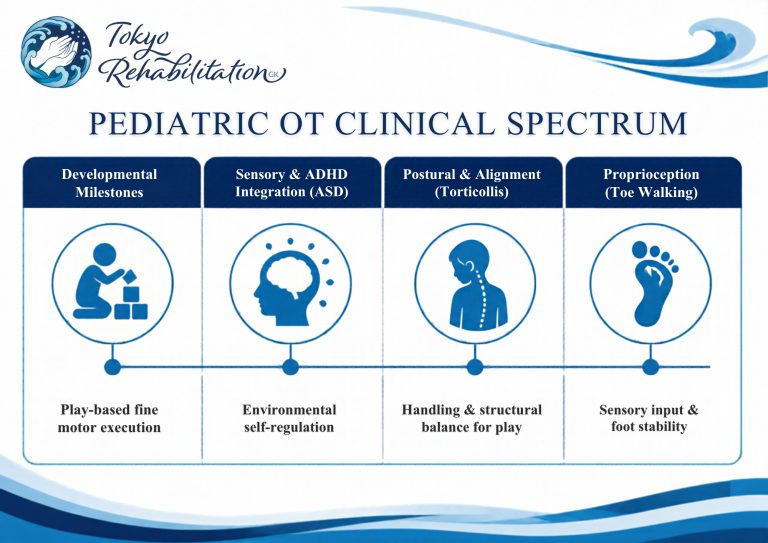
Developmental milestones are achieved as young ones interact directly with their physical surroundings. Pediatric occupational therapy will focus on using meaningful activities (mainly play). Therapists will help children develop fine motor skills, core stability for sitting at a desk, and visual motor skills for writing, using scissors, and eating.
Sensory Integration
For those with Attention-Deficit/Hyperactivity Disorder (ADHD) or Autism Spectrum Disorder (ASD), physical movements and sensory skills share deep connections. Occupational therapists will use Sensory Integration Therapy to improve the environment around the child, reducing sensory overload and providing structured sensory input. This will allow children to self-regulate, become more aware of their bodies, and concentrate.
Posture & Positioning
If a child is struggling with posture at an early age (plagiocephaly or torticollis), the focus will be on providing structure. Occupational therapists will work on positioning, handling, and adapting the environment to ensure asymmetry does not limit their physical abilities, such as reaching, rolling, grasping, and playing with both hands.
Physical Disabilities
When working with more complex neurological or physical conditions such as Cerebral Palsy (CP) or Developmental Coordination Disorder (DCD), occupational therapists will provide functional therapies.
Seating
Providing structured seating to help increase posture. This will allow the child to use their arms and hands freely.
Adaptive Equipment
Providing specialized equipment to help eat, fasten clothing and switch technologies to allow independent communication and play.
Adapting Environment
Adapting learning and living environments to remove physical obstacles and encourage independence.
Adult Physiotherapy & Occupational Therapy
When treating adults following surgery, trauma, or chronic illness.
Occupational therapists will provide structured exercises to help with musculoskeletal conditions, postoperative rehabilitation, and acute sporting injuries. They will help clients understand how to pace themselves, protect joints, and manage pain while providing practical recommendations to continue with daily activities.
Adaptive Approach
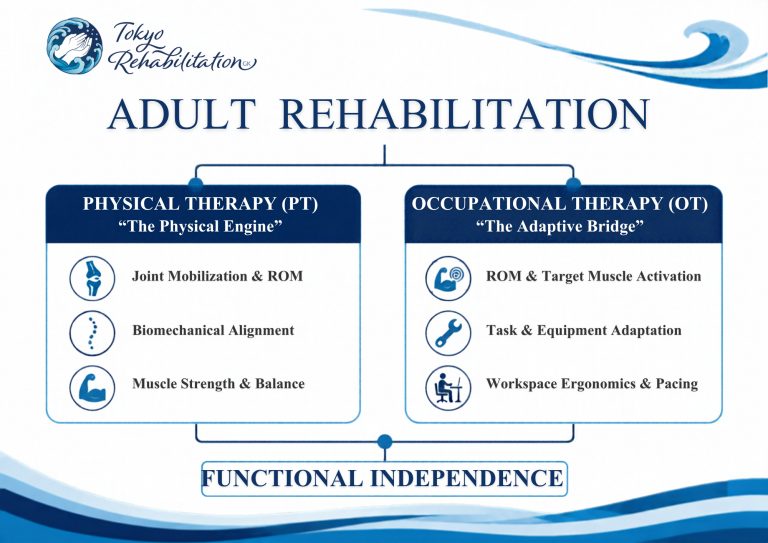
Occupational therapists use physical techniques such as range of movement (ROM), muscle strengthening, and joint mobilization. This will be very similar to Physiotherapy.
The main difference will be the use of an adaptive approach. Whilst a Physiotherapist will focus on muscle strengthening, joint function, and balance, an occupational therapist will analyse how these improvements can be applied to complete daily tasks.
If an adult client is struggling with hand strength and shoulder mobility, the occupational therapist will work on improving their strength; however, they will adapt the task:
– Providing specially shaped or weighted utensils to help them eat independently.
– Fastening their clothing differently, providing key turners and changing door handles to help them remain independent during early recovery.
– Adapting their home and work environment to provide an ergonomic setup.
Working Together at Tokyo Rehabilitation
The difference between Physiotherapy and Occupational Therapy should never be seen as a barrier. By combining our knowledge we can provide the best outcomes for our clients. An example would be if someone was recovering from a stroke.
Physiotherapy
The physiotherapy team will focus on improving the gross motor skills. This will include improving trunk balance and leg strength, normalizing walking patterns, and sitting-to-standing.
Occupational Therapy
The occupational therapy team will apply these improvements to complete daily tasks. They will work on improving upper limb control to hold a cup, getting dressed, safely using kitchen tools, and adapt the home.
By using both specialties, we will not get stuck in recovery. The improvements made during physiotherapy sessions will be applied to practical tasks during occupational therapy sessions. At Tokyo Rehab, we ensure that every element of our treatment relates to helping them gain independence.
Improving Movement & Daily Activities
Physiotherapy and Occupational Therapy will work together to provide a full rehabilitation. Physiotherapy will help improve strength, mobility, and gross motor skills. Occupational Therapy will apply this to improve fine motor skills, daily tasks, and independence.
Whether your child has a complex issue, you are recovering from an orthopedic procedure, or you have physical issues as an adult, we can provide a comprehensive treatment plan combining Physiotherapy and Occupational Therapy.
Contact our clinical team today to book an assessment.
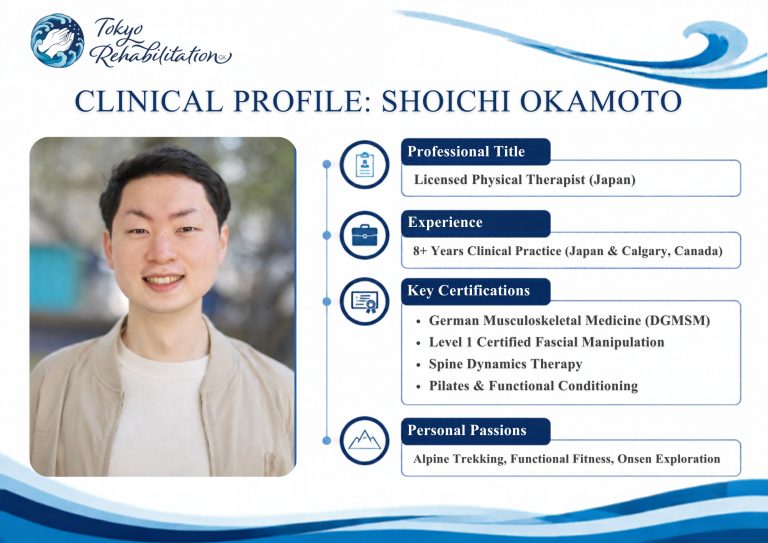
Introducing Shoichi Okamoto to the Tokyo Rehab Team
To provide collaborative physical therapy, we are pleased to introduce Shoichi Okamoto to our team in Tokyo.
Shoichi is a licensed Physical Therapist in Japan with over 8 years of experience. He has worked internationally as a Physical Therapy Assistant in Calgary, Canada.
He currently provides specialist treatment in a clinical and athletic setting in Tokyo.
Treatments Provided:
German Musculoskeletal Medicine (DGMSM): Advanced assessment and treatment of complex joint, muscle, and nerve issues.
Fascial Manipulation (Level 1 certified): Structured myofascial release and soft tissue techniques to improve joint mobility.
Spine Dynamics Therapy: Specialized therapy to improve spinal biomechanics, core stability, and alignment.
Pilates & Functional Therapy: Therapy to improve movement, focusing on core stability, injury prevention, and long-term recovery.
Outside of Clinical Practice
Outside of clinical practice Shoichi enjoys an active lifestyle. He loves going on multi-day treks in the mountains of Japan. He keeps himself physically fit with daily jogging and Pilates. He also enjoys visiting onsen (natural hot springs) such as Kusatsu and Ikaho. Shoichi provides specialist manual therapy, spinal therapy, and functional therapy to support our multi-disciplinary team.
Frequently Asked Questions: Occupational Therapy vs Physical Therapy
What is the difference between Physiotherapy and Occupational Therapy?
Physiotherapy will work on improving overall body movement, gross motor skills, muscle strength, joint mobility, and balance. Occupational Therapy will apply these skills to everyday tasks. They will work on improving fine motor skills and sensory skills and adapting to improve independence.
Can Occupational Therapists provide Physiotherapy treatments?
Yes! There is a lot of overlap between both professions. Occupational Therapists will often use Physiotherapy techniques when working with upper limbs. They will provide a range of movement, muscle strengthening, joint mobilization, and soft tissue to improve physical strength.
How do Physiotherapy and Occupational Therapy work together?
Physiotherapy and Occupational Therapy will work well together. The Physiotherapist will help improve the underlying movement, such as standing balance, leg strength, and walking. The Occupational Therapist will apply these improvements to help complete daily tasks such as getting dressed, cooking, working, and using tools.
How can Pediatric Occupational Therapy help children with ADHD or Autism?
Pediatric Occupational Therapy will use Sensory Integration Therapy and adapt the environment to help children with ADHD/ASD self-regulate their responses to sensory input. This will help them become more aware of their body and concentrate in academic, home, and social environments.
What is the adaptive approach used in Occupational Therapy with adults?
The adaptive approach will include physical therapy and adapting tasks. If an adult client has limited movement or strength, the Occupational Therapist will strengthen the tissues; however, they will adapt tools, techniques, and workplace ergonomics to allow them to complete everyday tasks independently during their recovery.
About Tokyo Rehabilitation
Founded by Mari Gish, PT, Tokyo Rehabilitation has served the English-speaking community in Japan for over 40 years. With state-of-the-art clinics in Shirokane, Minato-ku (Tokyo) and Kadena (Okinawa), our team of U.S.- and Japan-licensed physical therapists, osteopaths, and Pilates specialists provides compassionate, 1-on-1 rehabilitation and holistic wellness support.
We specialize in orthopedic and sports rehabilitation, Men and Women’s Pelvic Health, pre- and postnatal care, pediatric physical therapy, neurological recovery, specialized manual care, osteopathic techniques, and sympathetic nervous system downregulation. We accept international insurance policies and serve as an overseas Tricare provider.
Navigating a foreign healthcare system doesn’t have to mean compromising on the quality or style of your recovery. While Japanese National Health Insurance clinics offer an accessible option for quick, passive relief, private 1-on-1 physical therapy/physio bridges the cultural and linguistic gap for foreign residents who need comprehensive, active rehabilitation. By understanding how both models operate, you can confidently choose the pathway that best fits your specific injury, lifestyle goals, and peace of mind. If you are ready to tackle pain at its root with personalized, English-speaking care in Tokyo or Okinawa, reaching out to a dedicated physical therapy team is your best first step toward living fully and pain-free in Japan.
To learn more or schedule an appointment:
- Visit our website and book your appointment today so we can hear your story, assess your movement, and design a plan tailored to you. Tell us briefly what you are dealing with, and we will help match you with the right clinician.
- Call us directly; for all appointments, please call 03-3446-1682 or email us at info@tokyorehab.com
- Bring your questions. We will explain our findings in clear language and discuss how manual therapy, exercise, and lifestyle changes can work together for you.
- Tokyo Clinic: NIC Haimu Bldg, Suite 504, 3-4-1 Shirokane, Minato-ku, Tokyo 108-0072
- Okinawa Clinic: Lagoon Palace 4th Floor, 6 Chome-22-13 Mizugama, Kadena, Okinawa 904-0204
- Yokota Clinic: 697-22 Fussa, Fussa-shi Tokyo 197-0011